
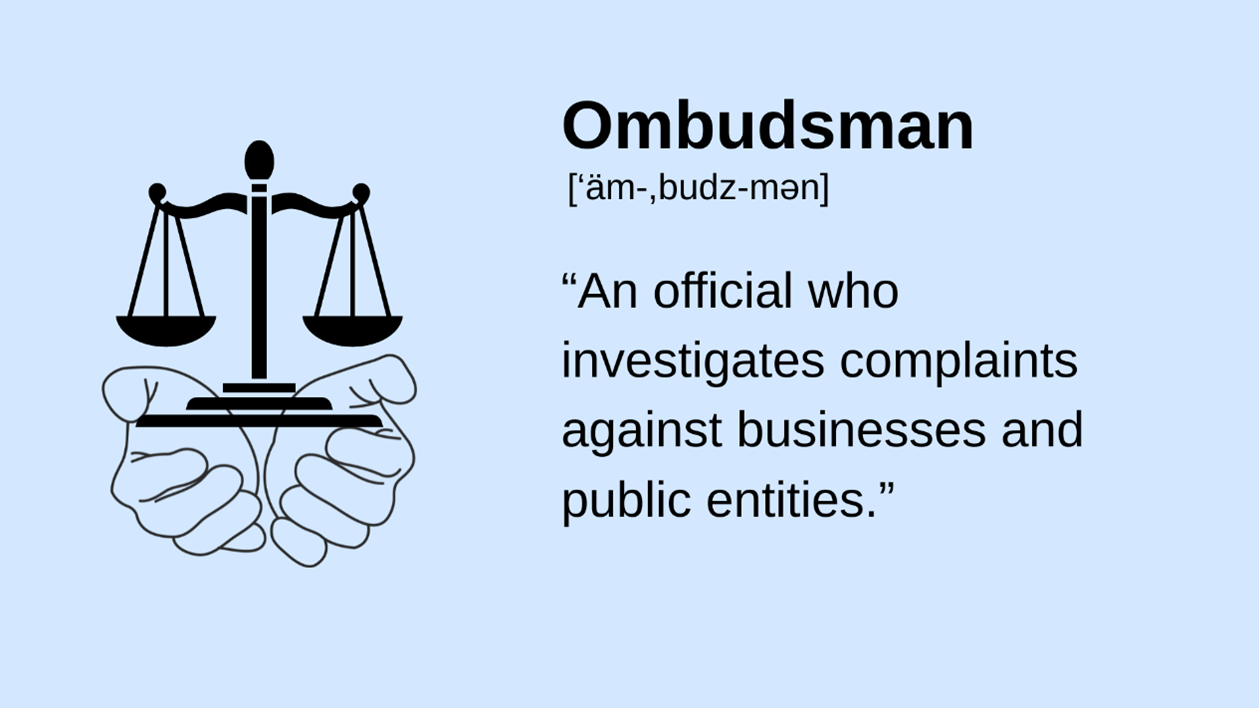
“Ombudsman”: a word borrowed from the Scandinavians
- An ombudsman is a government commissioner who investigates complaints free of charge and attempts to resolve them, usually through recommendations (binding or non-binding) or mediation. He also identifies systemic problems that lead to poor service delivery or violations of citizens’ rights.
- Etymologically, the term ombudsman originates from the Norwegian word umboðsmaðr, meaning “representative.” The Swedish Constitution of 1809 was the first to establish the Parliamentary Ombudsman (Riksdagens ombudsmän).
- Historically, the concept of mediation can be found in China (amhaeng-eosa), Rome (tribuni plebis), Arabia (ḥakam / ṣulḥ, Diwān al-Maẓālim), Greece (σασμός, πρεσβεία, διαλλαγή), India (panchayat), Japan (kugyō, chōtei), etc.
- The Ombudsman is an Alternative Dispute Resolution (ADR) process, such as mediation, arbitration, etc.
- The Ombudsman is usually appointed by the government or parliament or established by professional bodies in accordance with legally defined principles (independence, expertise, transparency, etc.).
- The Ombudsman may have a broad mandate covering the entire public or private sector or may be specialised.
- Ombudsmen are also found in health, education, insurance, the environment, communications, children, energy, pensions, labor, sports, transportation, the European Union, etc.
- In Greece, the Hellenic Financial Ombudsman handles disputes with banks, investment companies etc.